Apparently Goldman Sachs is having a hard time with the recession, they have put up their first quarter of losses since the financial crash. Poor, poor, little rich men. I can hear Daddy Warbucks crying all the way to the men's club to light up his illegal Cohibas with hundred dollar bills. Chalk up my lack of sympathy to the massive amount of un/der/employed all over DC protesting the man. It's hard to feel sorry for the very people who knowingly packaged bad mortgage loans, sold them to investors, and then bet against them. Not cool dude.
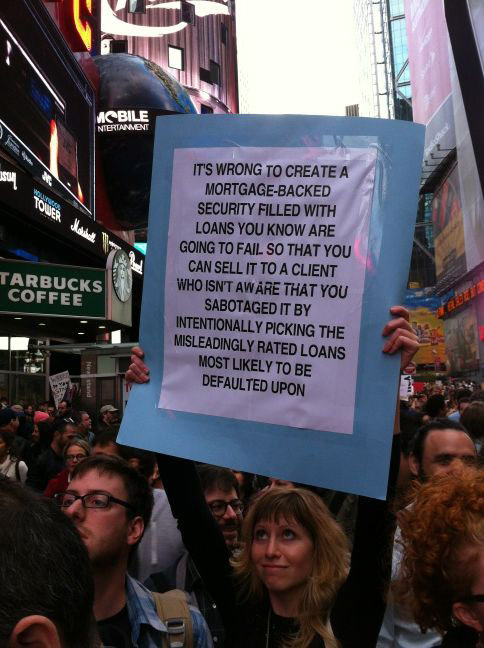
MIC CHECK!
But, in all seriousness, is the fact that the boys at Goldman Sachs are booking losses a good thing? Absolutely not, this is bad for the economy and doesn't bode well for the other banks. If Goldman Sachs is booking losses and failing to keep up with payments to the rest of Wall St, then the rest of the major banks are in danger of coming up short next quarter. Interbank lending is critical to a healthy economy, and if banks are fearful to lend to each other then the country could face a dangerous credit crunch. Considering the fragile state of the current economy, just a slight drop in the money supply is enough to destroy whatever confidence is left among consumers.
However, the article touched upon another important point. The regulations put in place in Washington are having an impact. Part of the reason that Goldman Sachs is not putting up massive profits anymore is because they've been forced to stop proprietary trading, and are lowering their lending because of the higher reserve requirements. The regulators are marking their territory all over New York. Morgan Stanley and JP Morgan Chase are booking smaller profits as well. Should we be happy that banks are going to be less profitable over the long run? After all, a wealthy Wall St means a healthy Main St. When credit is plentiful, loans are plentiful and Main St can properly expand their business and improve employment. Should the regulators ease off the pedal, or continue, full velocity of circulation ahead?
The regulators should be glad that banks are looking to be less profitable than they used to be. High profits for any industry leads to high wages. High wages attract smart people. After the Great Depression, and the strict regulations that followed, the financial sector attracted accounting nerds, geeks off the street, and while they earned their keep, banking was boring. Determining if someone can afford a loan was a numbers game, a simple assessment of their credit history and income. During this time smart people became doctors, or physicists, or invented the internet. In the 80s, the political winds shifted and Reagan presided over the first period of financial deregulation and banking took off.
 Smart people began to drift into finance. Instead of doing something they loved, like analyzing free market public policy, they turned to finance and got $alary (Look up: Dugan, Chris). Physicist stopped physicising and starting banking, creating complex financial instruments. The bankers suddenly became smarter than the regulators and created new financial tools that no one had heard of before. The argument that the financial sector should have smart people is that it inspires financial innovation, but has financial innovation been more innovative than destructive? The last decade would argue otherwise. We had an economy that was largely fueled by the financial sector and its "innovations", and the bottom 80% saw their share of income after taxes drop compared to the top 20%. After just two years, much of the growth from the last decade was wiped out when the mirage of money vanished, and all we got were these lousy mortgages.
Financial innovations weren't so much innovations than gimmicks. Smart people shouldn't be creating gimmicks, they should be creating new products that maintain the US' manufacturing advantage. Pushing brilliant people into the financial sector only created exotic methods of making money from money. Lowering the profits of the banking sector will force banking to become boring again. Instead of inventing a CDO, smart people will invent an IPad for your eyeball, we could call it an IEye. The regulators should be proud of their accomplishments so far, even if in the short term Goldman Sachs and Morgan Stanley are only able to book modest profits. Take away the massive bonuses, you take away their talent. Take away their talent and the investment banks won't be able to outsmart the regulators anymore.
Call me a socialist, but take away high wages from the banking industry and you get a reallocation of labor into industries that actually create something, other than more money.
So Regulators, MOUNT UP! Play me out Nate Dogg...

No comments:
Post a Comment