Friday, October 28, 2011

San Fran Fun

He's only five foot five
But he gets s**t done

Featuring, THE FOUNDER OF TWITTER!!!

ZOMG!!!!!!!!!!11


Thursday, October 27, 2011

California, here I come, right back where I started from

I'm in California this week, and realized how much I missed this place. I love California, it represents all that America should be. California is a state that truly takes in the tired, the poor, the huddled masses yearning to be free. We believe that immigration, foreign and domestic, is the engine to our economic renewal. There's an aura about us, and I have to say, it's all true. It also doesn't hurt that the weather is awesome. Haven't you heard, that's why happy cows come from California.

Being so cool and trendy, we tend to start fads that then spread to the rest of the country. Computers, Hollywood, tolerance, the OC, California culturally dominates this country. People often forget about the biggest fad of the past fifty years, and how it actually began in California. The modern conservative movement started in Southern California, near Brea and Yorba Linda among the early 60s robber barons--ahem--excuse me, job creators. Nixon, Reagan, Goldwater, they all can trace their ascension national politics from the white washed communities of Orange County. The New Right started in the suburbs of LA and found its voice during the 1964 California Republican Primary. Before Bill Clinton, California was reliably the Texas of the West in presidential elections.

Today's interpretation that California is a bastion of liberalism is somewhat misguided. We have a state legislature that requires a two thirds majority to raise taxes, and a public with a strong hyper-libertarian streak. A study of California government is a study in civic disfunction. The status of the Republican party as being more or less party in exile allows them to take out extreme positions on any budgetary matter. This uber minority has absolutely no responsibility in governing, they stake their claim, and refuse to compromise even though almost 66% of the chamber is in agreement. They own less than 40% of the seats in both houses and as such tend to come off as cantankerous old fools yelling nonsense proposals from the back bench.


"We need a 999 plan." "Oh, hold on let me grab a pizza menu."

California conservatives exemplify the Id of the Republican Party. They've never governed and as such have never been held accountable by the public for their intransigence in the face of much needed reform. The desire of the national GOP to endlessly obstruct any kind of congressional progress at the federal level directly lends its inspiration to California. The revenue component of last spring's "Cut, Cap, and Balance", is essentially in effect in California, and has been for years. If congress determines that no revenue increases should occur unless a 66% supermajority approves you'll find a country that can only deficit spend and never pay for its programs, effectively castrating government as a tool for social progress. Those roads, those public universities, those teachers, that public infrastructure that made this country an economic powerhouse after the war, all defunded because the government couldn't approve revenue measures. It happened in California, it will happen on a national level if those types of revenue restrictions are put in place.

California once had the strongest infrastructure that supported the strongest economy in the country. Once Proposition 13 passed in 1978, all that changed. California's schools have fallen to the bottom, we have entire cities that are going bankrupt and cannot even afford a fire or police department (see: Vallejo, San Jose). There are sections of the San Francisco Bay Area that are starting to look like the third world (see: Richmond). Let me repeat, not the Inland Empire, not the Central Valley, the Bay Area. Help for the middle class can't even come to a region with a booming tech sector. If the California fad of civic disfunction spreads to the federal government, look forward to the abandonment of investment in our future.

Thursday, October 20, 2011

Finally Something Chris and I might agree on...

Now if only he'd post his items on the blog and not under comments, our one reader...maybe two...could see his input.

News has came out that Gaddafi is dead. Last week, Anwar al-Awlaki was killed in a raid in Yemen. Osama Bin Laden was taken out earlier this year. All were taken out by soldiers, whether they be the US military, or a rebel soldier who likes the Yankees...better than a Red Sox fan. God I hate the Red Sox...but I'll save that for a later post.
Something about the way they died doesn't sit well with me. Don't get me wrong, I despised those guys. I remember doing more than a few fist pumps after hearing that Osama Bin Laden was killed...dude was a douche. All Americans were affected by 9/11 and Gaddafi was a straight up ass donkey. But, I despise child molesters, and would never condone the state killing them. Anwar al-Awlaki was born in New Mexico and grew up a US citizen. Even if you think capital punishment is justified, is it fair to execute an American citizen without a trial? You could argue that Gaddafi and Bin Laden were special cases considering the events surrounding their deaths. If you believe the media accounts, to say that Bin Laden was resisting arrest would be a massive understatement, he supposedly was taking pregnant women hostage, not a noble way to go out. Gaddafi was killed by the aforementioned Yankees fan after being wounded in a NATO air raid, an event outside of US control.

Anwar al-Awlaki was straight up killed in a drone raid, and so was his 17 year old cousin a couple of days later (a boy who was born in Denver, and is also a US citizen). Shouldn't we be taking this into account when ordering a raid? We're not at war with New Mexico and Colorado, these aren't foreign combatants, these are American citizens. Whether they deserve it or not, they have constitutional protections.

Personally, I don't support the death penalty, I find it barbaric and out of line for a civilized society. The countries that executed the most people in 2010, from first to fifth, were China, Iran, North Korea, Yemen, USA. I don't find that a great list to be on, but state sanctioned murder is a debate for another day. If you believe that the state should execute law breakers, I understand the argument that Bin Laden and al-Awlaki deserved to die. Especially when you take into account who the US executes today, Bin Laden and al-Awlaki have committed more heinous crimes than most, if not all, executed convicts and should be subjected to the death penalty. But should a US citizen be executed without due process? At the very least should we have singled out al-Awlaki for a court trial for crimes against the state? Wouldn't it be more cathartic for the American people to have a trial and then execute them in a public hanging, wouldn't that have satisfied the US' blood lust?

Tumblr Fun

Because not everything on this blog should be wonky (read: boring) analysis.


AND because we're moderately political here at the Anti Center Policy Centre.

Wednesday, October 19, 2011

Regulators, Mount Up!

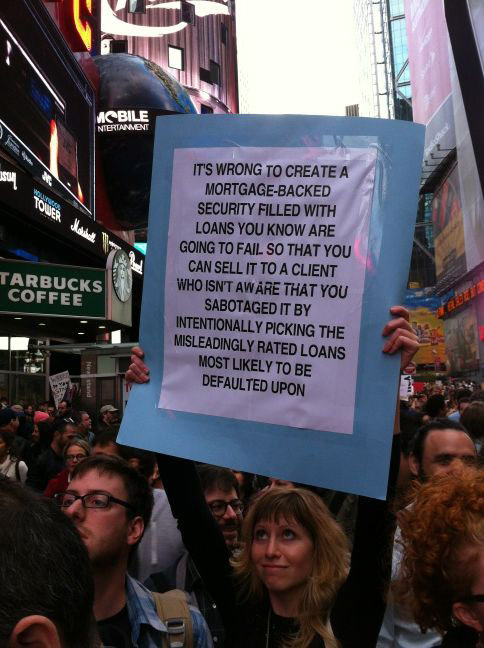
Apparently Goldman Sachs is having a hard time with the recession, they have put up their first quarter of losses since the financial crash. Poor, poor, little rich men. I can hear Daddy Warbucks crying all the way to the men's club to light up his illegal Cohibas with hundred dollar bills. Chalk up my lack of sympathy to the massive amount of un/der/employed all over DC protesting the man. It's hard to feel sorry for the very people who knowingly packaged bad mortgage loans, sold them to investors, and then bet against them. Not cool dude.


MIC CHECK!

But, in all seriousness, is the fact that the boys at Goldman Sachs are booking losses a good thing? Absolutely not, this is bad for the economy and doesn't bode well for the other banks. If Goldman Sachs is booking losses and failing to keep up with payments to the rest of Wall St, then the rest of the major banks are in danger of coming up short next quarter. Interbank lending is critical to a healthy economy, and if banks are fearful to lend to each other then the country could face a dangerous credit crunch. Considering the fragile state of the current economy, just a slight drop in the money supply is enough to destroy whatever confidence is left among consumers.

However, the article touched upon another important point. The regulations put in place in Washington are having an impact. Part of the reason that Goldman Sachs is not putting up massive profits anymore is because they've been forced to stop proprietary trading, and are lowering their lending because of the higher reserve requirements. The regulators are marking their territory all over New York. Morgan Stanley and JP Morgan Chase are booking smaller profits as well. Should we be happy that banks are going to be less profitable over the long run? After all, a wealthy Wall St means a healthy Main St. When credit is plentiful, loans are plentiful and Main St can properly expand their business and improve employment. Should the regulators ease off the pedal, or continue, full velocity of circulation ahead?

The regulators should be glad that banks are looking to be less profitable than they used to be. High profits for any industry leads to high wages. High wages attract smart people. After the Great Depression, and the strict regulations that followed, the financial sector attracted accounting nerds, geeks off the street, and while they earned their keep, banking was boring. Determining if someone can afford a loan was a numbers game, a simple assessment of their credit history and income. During this time smart people became doctors, or physicists, or invented the internet. In the 80s, the political winds shifted and Reagan presided over the first period of financial deregulation and banking took off.

Smart people began to drift into finance. Instead of doing something they loved, like analyzing free market public policy, they turned to finance and got $alary (Look up: Dugan, Chris). Physicist stopped physicising and starting banking, creating complex financial instruments. The bankers suddenly became smarter than the regulators and created new financial tools that no one had heard of before. The argument that the financial sector should have smart people is that it inspires financial innovation, but has financial innovation been more innovative than destructive? The last decade would argue otherwise. We had an economy that was largely fueled by the financial sector and its "innovations", and the bottom 80% saw their share of income after taxes drop compared to the top 20%. After just two years, much of the growth from the last decade was wiped out when the mirage of money vanished, and all we got were these lousy mortgages.


Financial innovations weren't so much innovations than gimmicks. Smart people shouldn't be creating gimmicks, they should be creating new products that maintain the US' manufacturing advantage. Pushing brilliant people into the financial sector only created exotic methods of making money from money. Lowering the profits of the banking sector will force banking to become boring again. Instead of inventing a CDO, smart people will invent an IPad for your eyeball, we could call it an IEye. The regulators should be proud of their accomplishments so far, even if in the short term Goldman Sachs and Morgan Stanley are only able to book modest profits. Take away the massive bonuses, you take away their talent. Take away their talent and the investment banks won't be able to outsmart the regulators anymore.

Call me a socialist, but take away high wages from the banking industry and you get a reallocation of labor into industries that actually create something, other than more money.

So Regulators, MOUNT UP! Play me out Nate Dogg...


Tuesday, October 18, 2011

Welcome!

Hello All,

Welcome to Get Your Wonk On, a forum intended for a discussion focused on public policy. We are Chris Dugan and Aaron Pervin, a libertarian and a liberal, a Connecticutian and a Californian, who will argue on all things politics and policy, Giants-NY and Giants-SF, football and frisbee, really anything that has a semblance of alliteration.

While we do agree on some issues, drug policy, gay marriage, we disagree on just about everything else. We will use numbers, political philosophy, humor, anything that will prove our point. And yes...sometimes we play dirty.

We hope you like it, and we look forward to the discussion.

Love,
Aaron and Chris, almighty alliterates, political pontificators, mental masturbators, and erudite extraordinaires!

Too much? Perhaps, but that's how we roll! Now, let's begin.

Aaron's Hypocrisy:


Chris' Hypocrisy:


Speaking of legalizing it...

While regulating it because there exists some negative externalities...


Liberalism and the bumper sticker problem

I got into a friendly argument with a friendly stranger the other day about the place liberalism and the market should have in society. I realize that many within my generation are generally more receptive to cultural liberalism and economic progressivism. However, there are still plenty who espouse moderate social views and economic libertarianism on my right. Christopher Breen Dugan, you will find is one of them. I find it interesting that many of them have a mistaken view of liberalism; that its objectives are to break down the free market and create a centralized authority that would have more power to plan an economy. Nothing could be further from the truth. Liberalism, as defined after the Great Depression, has always been consistent. It is, in a way, institutionalism, or having faith in the current societal structure to promote economic advancement for all. This in no way means that we want to destroy the free market, instead we believe that certain industries within the free market should be moderately regulated in order to ensure future prosperity. Additionally, liberalism would argue that government should step in when it is financially efficient to have outright control of an industry, say national security or public education. Liberalism is often confused with radicalism, a notion that has more in common today with the right than the left, which is the desire to drastically scale down the various societal organs and start from scratch. Lefty radicals would desire the remade society to be centralized, while the right decentralized.

This nuance in argument is the primary reason that liberalism finds it hard to create those fine tuned sound bites which can attract attention and stir the public into action. A libertarian bumper sticker could say, "Free Market: Arbiter of Justice", the liberal bumper sticker would have to retort with, "Free Market: Arbiter of justice, only if there existed a perfect market for goods and services." How the hell can that fit on a 4x12 magnet? Or even, "LEGALIZE IT!", would have to turn into, "Legalize it, but regulate it because there exists some negative externalities". Think of the car accidents caused by reading that. That reminds me, we should probably mandate that bumper stickers have a large enough font in the name of road safety.